



In Memoriam: Krisztián Vértes (1976–2025), Part II – Recording Ancient Egypt in the Digital Age: The Epigraphic Work of Krisztián
This article continues the commemoration of Egyptologist and artist Krisztián Vértes (1976-2025) with the focus on his contributions to digital epigraphy. It presents five key projects from his career that illustrate how he expanded established epigraphic practice through digital tools, and how digital workflows can respond to monuments whose complexity challenges traditional documentation.
Written by Júlia Schmied, Egyptologist, Museo Egizio
From Imiseba to Philosophy of Epigraphy, 1998-2011

Southern Front Wall, Tomb of Imiseba, TT 65 (inked, color-coded detail).
Krisztián’s engagement with epigraphy began with the documentation of the wall paintings in the late Twentieth Dynasty Theban Tomb of Imiseba (TT65), a project carried out over more than a decade, between1998 and 2011. The exceptional quality of the paintings demanded more than technical proficiency: it required a nuanced understanding of ancient Egyptian visual language, compositional principles, and painterly practice. From the outset, the task raised important questions about how such surfaces could be recorded in a way that preserved both the finest details and the coherence of the overall design, while acknowledging that any act of documentation is necessarily an act of selection and interpretation. The scale of the tomb’s decorated walls – some extending over ten by four meters – together with the complexity of their decorative history, presented challenges that existing recording methods could not easily address.
TT65 was cut into the northeastern face of Sheikh Abd el Qurna on the Theban west bank, originally intended for the official Nebamun under the reign of Hatshepsut.[1] Although the traverse hall was fully prepared for decoration, it remained unfinished: most walls preserve only preliminary sketches, while the east walls include a few exceptionally fine raised reliefs. During the second half of the Twentieth Dynasty, the tomb was reused by Imiseba, an important member of the Theban Amun clergy, who enlarged the tomb with a longitudinal hall, repaired damaged areas, covered earlier reliefs with gypsum plaster, and redecorated it with wall paintings. Imiseba’s decorative program exhibits the finest examples of late-Ramesside artisanship. Not only is it distinctive in its theme covering mostly temple and royal scenes, but it is also unique in the way every wall was decorated with a single monumental scene depicting a particular event, for instance the Opet and New Year’s Festival. In Late Antiquity, the tomb became part of the Monastery of Cyriacus, leaving Coptic crosses, graffiti, and extensive defacement on the wall surfaces. As a result of all this activity, the tomb’s walls present a complex palimpsest of multiple phases and uses.
In response to the epigraphic challenges posed by such complex wall surfaces, Krisztián developed what became known as the Imiseba method, an entirely analogue recording system that nevertheless already embodied many of the ideas that would later shape his digital work. From the beginning, his approach was guided by four objectives, which he carried with him throughout his career[2]:
· Preservation – presenting the paintings in their original context as realistically and precisely as possible, with full attention to stylistic accuracy.
· Interpretation – synthesizing and visually rendering all available information about the decorated surface, including preliminary sketches, later modifications, and subsequent damage.
· Representation – creating a facsimile that is comparable in quality to the original and could stand alone as a work of art.
· Integration – treating individual wall scenes as part of a larger decorative program.
The cornerstone of the Imiseba method was to produce facsimiles that conveyed as much information as possible. To achieve this, a series of criteria were set for the documentation process:
- Each wall had to be treated as an inseparable unit and represented as an individual painting, resulting in an unprecedented volume of documentation for a private tomb.
- Even when reduced for publication, the smallest details had to remain visible, since they gave the paintings their distinctive character.
- Color, as the most essential element of the original design, had to be given a central role. Instead of restricting the record to outlines, the facsimiles were conceived as colored surfaces, using a coded system to restore the intended hues of the ancient painters.
- Finally, all secondary visual data – damage, preliminary sketches, graffiti, and later alterations – were to be registered alongside the paintings themselves, so that the facsimiles preserved the full, layered history of the walls.
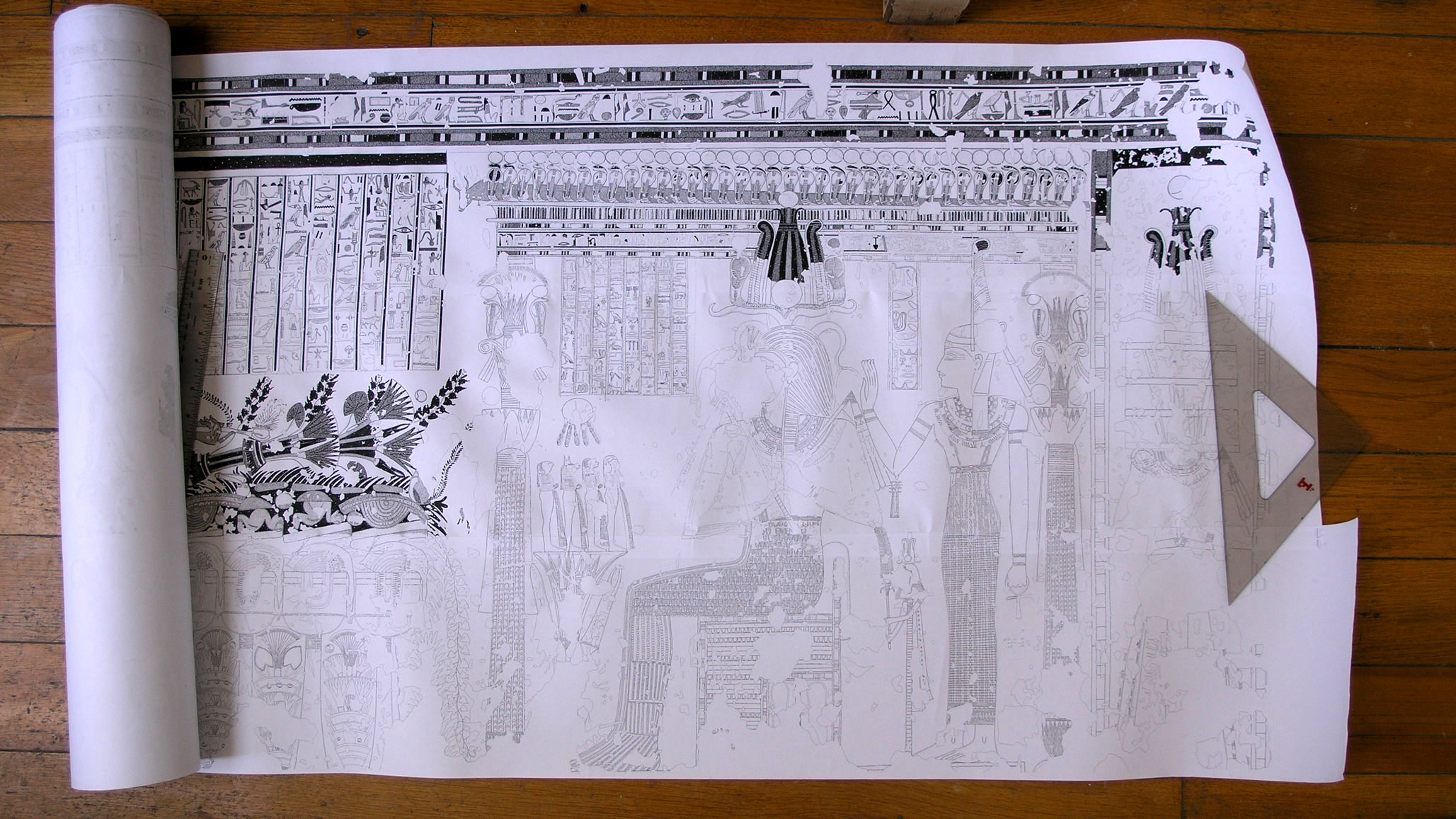
Color-code already partially applied over the outlineof the Southern back wall, 2008.
Translating these principles into practice required a painstaking and carefully organized process. Fieldwork at TT65 relied on highly structured, large-scale facsimile method designed to capture the walls with maximum accuracy. Each wall was first mapped at reduced scale to organize hundreds of transparent sheets of film, onto which 1:1 pencil copies were drawn with soft graphite to minimize pressure on the surface. Not only were figures and inscriptions carefully traced, but also the orientation and taper of each brushstroke in order to capture the ancient painters’ style as precisely as possible. Secondary data were faithfully included using distinct graphic conventions. Color photography served as primary reference for chromatic information, while the epigraphic documentation emphasized the artists’ design choices rather than literal appearance. To address fading and alteration, colors were recorded according to their original values and translated into a standardized greyscale dot-pattern system, allowing even the finest details to be coded consistently.
In the studio, these full-scale pencil drawings were inked by hand with Rapidograph pens, assembling each wall from overlapping segments and using varied line weights to preserve multiple layers of information. Once reduced to 1:4, scanned, and reassembled, the drawings underwent an extensive manual color-coding process, applying the dot patterns freehand – often over hundreds of hours per wall. Although created without digital tools, the facsimiles were later digitized, cleaned, and archived, ensuring that this labor-intensive, analog epigraphic record could be preserved and integrated into modern digital workflows.
The documentation process of TT65 also anticipated many of the directions epigraphy would later take. By layering information, insisting on stylistic precision, and balancing detail with overall composition, Krisztián demonstrated that epigraphy could be at once rigorous and interpretive, technical and artistic. At the same time, the immense effort required to produce such drawings by hand revealed the limits of traditional facsimile methods and inspired him to envision more flexible solutions for the future.
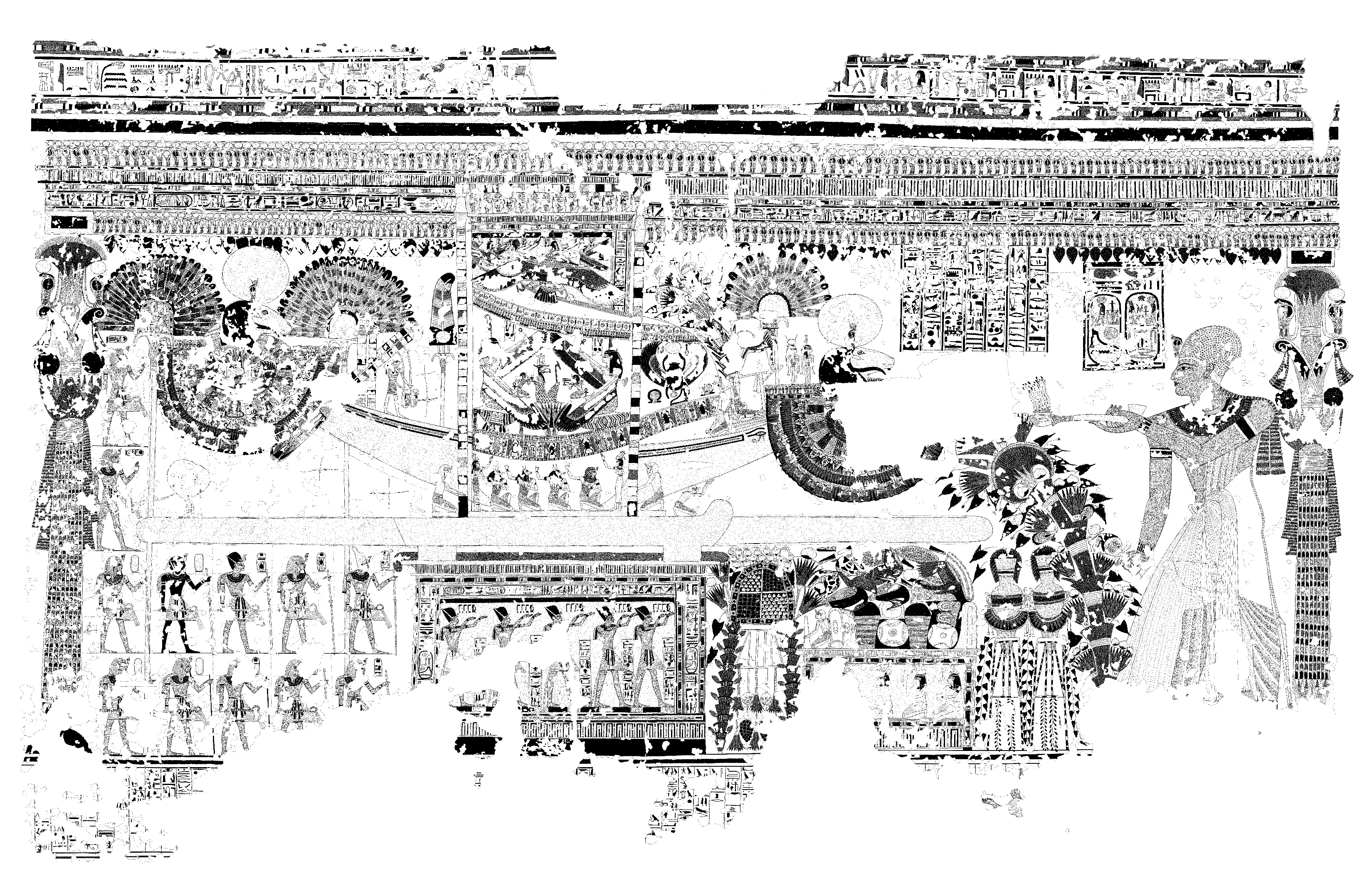
Southern End Wall, Tomb of Imiseba, TT65 (inked, color-coded final version).
From the Chicago Method to Digital Epigraphy, 2005-2014
Krisztián joined the Epigraphic Survey of the University of Chicago at Chicago House, Luxor in 2005, becoming part of one of the most influential documentation traditions in Egyptology. Conceived in the early 1920s by James Henry Breasted, the Epigraphic Survey was founded as a long-term program to record Egypt’s monumental inscriptions with a degree of accuracy sufficient to stand in for the original monument as it inevitably deteriorates. This principle continues to define what is commonly referred to as the Chicago House method[3].
The method was developed in response to the limitations of earlier copies and to the realization that photography alone was insufficient for recording complex or damaged reliefs and inscriptions. Large-format photographs provide a proportionally accurate basis for documentation, but drawing remains central to the process, allowing carved and painted details to be clarified, interpreted, and selectively emphasized. Documentation is carried out through close observation at the monument and relies on collaboration between photographer, artist, and epigrapher. Drawings are repeatedly checked against the wall through successive stages of collation, ensuring that interpretation remains grounded in direct examination of the original surface.
Working within this framework was formative for Krisztián. The Chicago method offered a structured approach to observation, a shared visual language, and a multi-stage system of checking and correction at the monument, all of which aligned closely with principles he had already developed during the Imiseba project. At the same time, the reliance on largely static, finalized drawings highlighted questions that had already emerged in his earlier work, particularly concerning flexibility, the representation of multiple layers of information, and the documentation of monuments whose complexity exceeded the limits of conventional workflows.
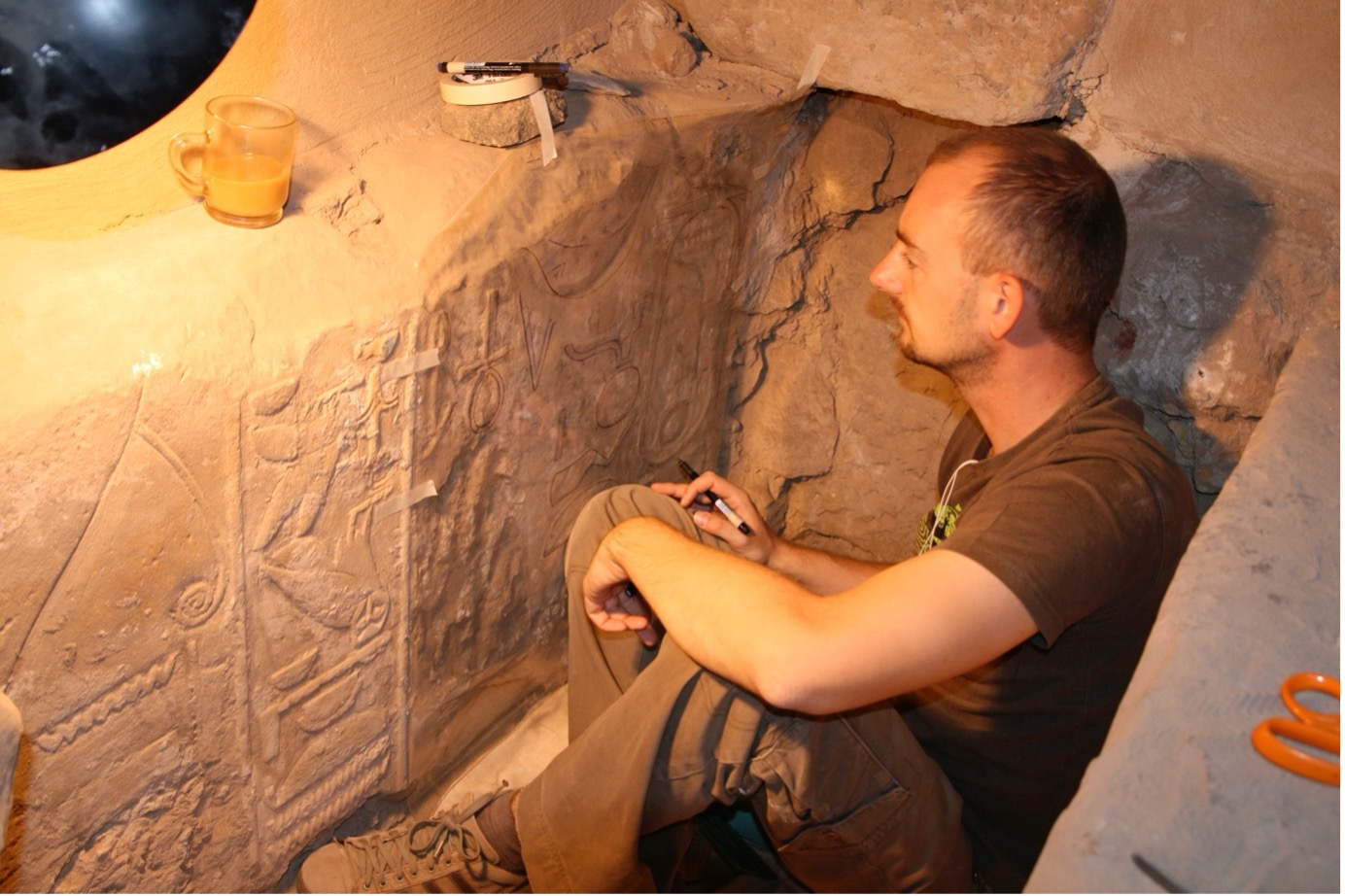
Tracing upside down relief fragments in the Khonsu Temple, Karnak, 2008.
His engagement with digital technology developed from within this context. Krisztián did not approach digital epigraphy as an alternative to traditional methods, nor as a means of accelerating or simplifying documentation. He was critical of assumptions that digital tools reduced the need for skill, experience, or close observation. At the same time, he recognized practical limitations within traditional practice, including prolonged physical contact with fragile surfaces, the difficulty of revising completed drawings, and the loss of quality introduced during repeated scanning and reduction for publication.
Digital fieldwork, however, introduced its own constraints. Environmental conditions, limited mobility, and the physical demands of working at the wall required careful consideration of tools and workflows. Krisztián therefore argued that digital documentation should remain as close as possible to the traditional drawing process in the field, reserving more complex processing and refinement for the studio. Lightweight equipment, limited software interaction, and clearly defined task sequences were essential. Within these parameters, digital tools could be integrated as extensions of established epigraphic principles, allowing information to be organized, layered, and revised without departing from the methodological foundations of the Chicago House tradition.
The four projects discussed below demonstrate how Krisztián integrated digital techniques into traditional documentation methods.[4] They are presented not in strict chronological order, but as a sequence of methodological case studies, each addressing a specific epigraphic problem and reflecting a different aspect of Krisztián’s evolving digital practice. Each was developed with the same underlying principles in mind, yet each responds to different material and methodological challenges. All four build on established epigraphic practices, extending conventional procedures through digital means rather than replacing them.
Reconstructing the Thutmoside Bark Sanctuary Doorway in the Small temple at Medinet Habu, 2007-2015
.gif)
Bark Sanctuary, Small Amun Temple, Medinet Hab, MHB 163-165 (composite, inked, layered).
Krisztián’s first opportunity to fully articulate a digital epigraphic approach within the Chicago House tradition came with the documentation of the outer west doorway of the Thutmoside Bark Sanctuary in the Small Amun Temple at Medinet Habu. From the outset of the epigraphic process, it became clear that the task went beyond recording a decorated surface but required the documentation – and partial reconstruction – of an entire architectural unit. The doorway preserves an exceptionally complex decorative history, combining fragmentary Eighteenth Dynasty reliefs, later Ptolemaic modifications, reused architectural blocks, and multiple phases of painting. Addressing this complexity demanded a composite drawing capable of holding architecture, relief, paint, damage, reuse, and reconstruction together within a single visual framework.
Originally built under Thutmose III, the exterior doorway of Bark Sanctuary was articulated with a torus molding, cavetto cornice, kheker frieze, and painted raised reliefs executed according to Thutmoside conventions. This configuration was profoundly altered over time. Amarna-period iconoclasm was followed by post-Amarna restoration; seismic activity displaced blocks and disrupted alignments; and extensive Ptolemaic rebuilding introduced new carving, thick plaster infills, repainting in a markedly different style, and the replacement of the original lintel with a larger, unfinished one. Further block replacement and later plaster coatings – partially removed in modern times – added additional layers of damage and visual disruption. Multiple historical states thus coexist on the same surface, often fragmentary and misaligned.
Given this complexity, conventional paper-based workflows proved insufficient. Digital drawing, carried out on site using Adobe Photoshop on a Cintiq Companion, offered the flexibility Krisztián needed to manage the architectural scale of the monument and the multiplicity of historical layers it preserved. The project began with the creation of a precise digital architectural elevation of the entire wall section, into which all existing photographic documentation – both recent and archival – was integrated. This composite background provided the structural and historical framework for digital drawing carried out directly at the monument.
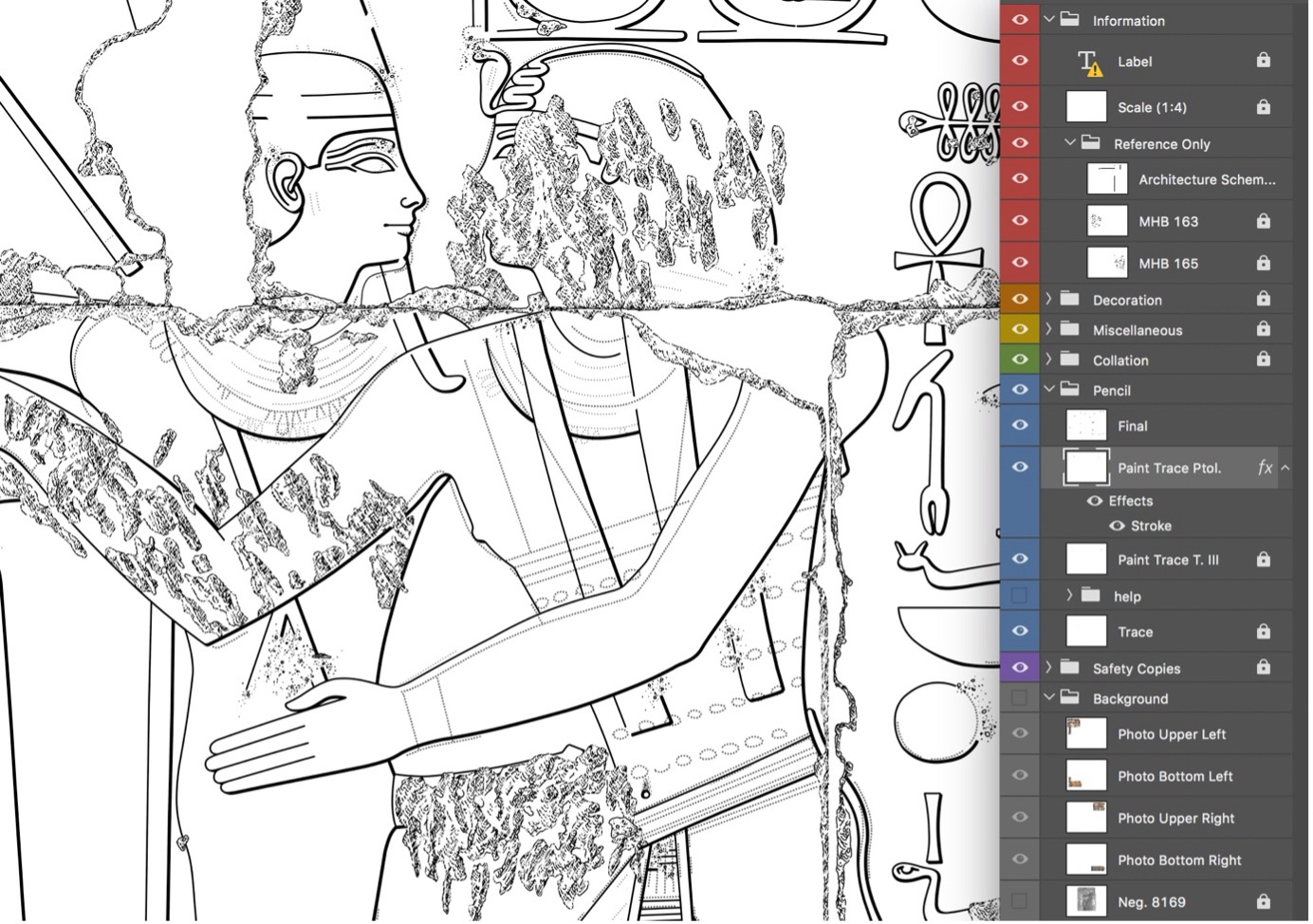
Layer arrangement of the composite pencil drawing (MHB 163-165).
Throughout the fieldwork, Krisztián sought to keep the digital drawing experience as close as possible to traditional pencil drawing. Custom pressure- and size-sensitive brushes were developed to reproduce the behavior of graphite, while digital guides supported the control of long curves and complex architectural elements. At the same time, the layered structure of the digital file allowed different categories of information – architecture, relief, paint, damage, and reconstruction – to be developed independently, without visually overloading the drawing. Once field drawing was complete, the project entered a second, carefully structured studio phase. The drawings were brought up to Survey standards, earlier low-resolution elements were replaced with archival-quality material, and the composite file was consolidated into a coherent multi-layer system. Digital inking followed established Chicago House conventions, preserving the traditional sun-shadow line weights and graphic treatment of damage and paint, ensuring that the final drawings remained fully compatible with the Survey’s publication tradition.
The same framework also made precise reconstruction possible. Two reused Thutmoside blocks embedded in the later Ptolemaic doorway could be isolated and repositioned within a hypothetical Eighteenth Dynasty layout through careful measurement and comparison with better-preserved doorways elsewhere in the temple. By placing this reconstruction on a separate digital layer beneath the drawing of the monument as preserved, Krisztián was able to record each phase independently while their spatial and historical relationships remained visible – an approach that would have been difficult to achieve with traditional paper-based methods alone.
Rather than replacing established epigraphic practice, the project showed how digital tools could extend the Chicago House method. Observation, stylistic fidelity, and repeated verification at the monument remained fundamental; what changed was the ability to manage complexity. Architecture, relief, paint, damage, and reconstruction could be brought together within a single, flexible visual system, making this doorway a testing ground for documenting monuments whose layered histories exceed the limits of conventional workflows.
.gif)
Bark Sanctuary, Small Amun Temple, Medinet Hab, MHB 163-165 (Early Ptolemaic composite).
Enhanced Color Comparison Drawings of the Eighteenth Dynasty Façade in the Small Amun Temple at Medinet Habu, 2012-2020
@300dpi.gif)
North Wall in Annex R, Small Amun Temple, Medinet Habu (Ptolemaic color scheme), 2021.
The representation of color remains one of the least fully developed areas of epigraphic documentation. Traditionally, painted details were either omitted for clarity, reduced to dotted outlines, or translated into black-and-white pattern fills. Even when exceptional full-color facsimiles were produced, they tended to remain isolated cases. With the rise of digital photography, color came to be treated increasingly as a photographic supplement rather than as an integral part of epigraphic interpretation. Yet at Medinet Habu, the condition of the Eighteenth Dynasty façade of the Small Amun Temple presented a situation in which photography alone could not convey the richness, structure, or historical development of the painted decoration.
Much of the façade preserves only faint pigment scars – too fragmentary to reconstruct an idealized original appearance, yet too significant to be ignored. The challenge was not to restore lost color, but to make the surviving traces legible and comparable, and to show how successive decorative phases related to one another. Krisztián approached this problem by developing an enhanced color comparison method that treated color as evidence for understanding the monument’s history, not as a decorative addition.
The project began from existing Chicago House line drawings, which provided the epigraphic framework. Over these, color information was first recorded in a traditional way: using color pencils on matte acetate to strengthen and clarify pigment traces observed on the wall. These drawings did not introduce new hues, but amplified what was still present on the wall, using cross-hatched textures to clarify density, transitions, and wear. The emphasis was not on restoring brilliance, but on making faint information visible and comparable.
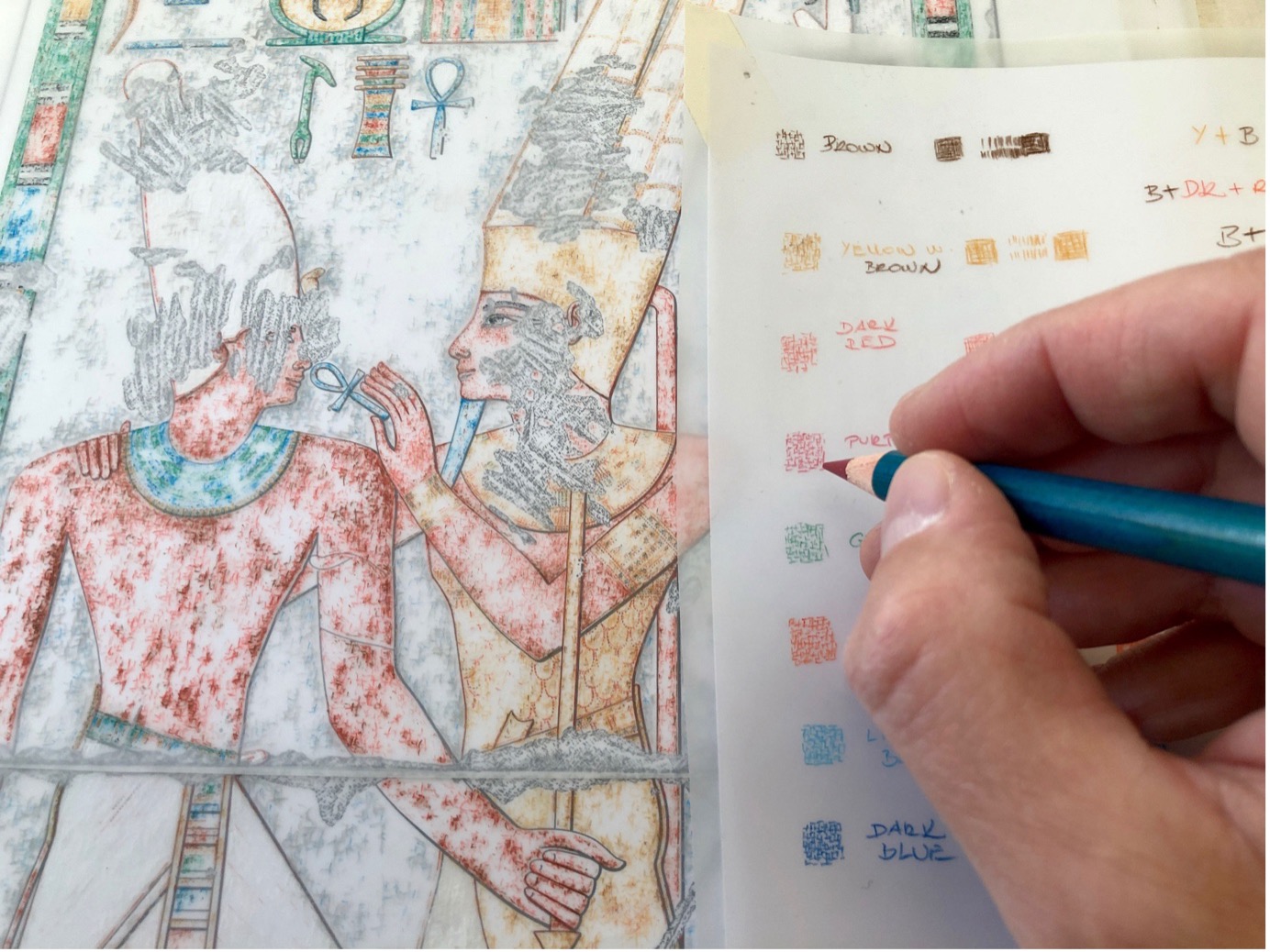
Drawing color samples on mylar for each hue that was applied on the enhanced color pencil drawing, MHB 95.
These hand-drawn color studies were then digitized and became the foundation for a hybrid workflow in which traditional and digital techniques were deliberately interwoven. Custom digital brushes were created from the scanned pencil textures, allowing the same visual language to be extended across larger surfaces with greater control. Smaller, highly detailed areas were documented with tablet-based drawing on an iPad Pro, while larger architectural elements – such as torus moldings, cavetto cornices, and deeply cut hieroglyphs – were more efficiently addressed in the studio using a Wacom tablet and Photoshop, without loss of nuance. Manual and digital strokes were not opposed but deliberately blended, preserving continuity of appearance while gaining flexibility of scale.
Because the façade had undergone multiple episodes of repainting and modification – from the Thutmoside period through Ramesside interventions to a complete Ptolemaic redesign – the goal was not a single colored reconstruction. Instead, Krisztián selected a single vertical section with the best-preserved pigment as representative of the six-pillared façade. For each historical phase, only extant color was enhanced, while the same areas of damage were retained across all versions. Later additions were removed digitally from earlier phases, allowing each stage to be viewed as a distinct historical moment before subsequent alteration, yet already bearing the marks of age and decay.
Line drawings, color layers, architectural additions, and photographic backgrounds were combined into a single composite system in which individual phases could be isolated or compared directly. Neutral backgrounds were introduced to clarify the role of whitewash – an essential but often overlooked component of Egyptian wall painting – and optional photographic layers reinforced spatial depth where necessary. The result was not a series of idealized reconstructions, but a controlled visual comparison of decorative states.
Through this project, Krisztián expanded digital epigraphy beyond the documentation of line drawing to include color as an essential component of the epigraphic record. The enhanced color drawings made it possible to distinguish at least four major decorative phases and to study their relationships within a single visual system.[5] As with the Bark Sanctuary doorway, the innovation lay not in replacing established epigraphic conventions, but in extending them – using digital tools to organize, compare, and preserve information that would otherwise remain invisible or inaccessible.
.jpg)
Historical Evolution of the Eastern Façade, Small Amun Temple, Medinet Habu: 1. Original Thutmoside phase; 2. Ramesside phase; 3. Late Ramesside/Third Intermediate Period interventions; 4. Ptolemaic phase (Color composite with photo background).
Representing Painted Walls in Grayscale: Theban Tomb 179 (Nebamun), 2011-2020
.gif)
Antechamber, West Wall, Tomb of Nebamun , TT 179 (reconstruction).
The documentation of Theban Tomb 179, the early Eighteenth Dynasty tomb of Nebamun, located on the southern slope of el-Khokha, required yet another methodological response to a very different set of epigraphic conditions. Unlike the Small Amun Temple at Medinet Habu, where color survives only in faint traces, the painted decoration of TT 179 is often exceptionally well preserved, digital photography could therefore supply reliable color information. At the same time, the wall scenes are disrupted by extensive damage: collapsed wall sections, deliberate ancient vandalism, geological cracking, and large areas quarried away in antiquity. These interruptions fragment the compositions and make it difficult to grasp the scenes as coherent visual units.
A further complication lies in the technique of the decoration itself. In the antechamber, Nebamun’s scenes were executed as painted raised relief, in which carving and paint operate as distinct but interdependent layers. Relief outlines provide a sculptural framework, while paint adds refinement, detail, and sometimes elements that do not correspond exactly to the carved forms. Any epigraphic method had to preserve the precise relationship between these two layers without allowing one to obscure the other.
For this reason, Krisztián developed a hybrid documentation strategy centered on grayscale color-coded facsimiles already tested at Imiseba but adapted to a new technical and visual context. The method relied on two separate in situ tracings of the same scene: one on clear acetate capturing the relief, and another on opaque matte acetate recording the painted details. Carefully placed reference points ensured that the two layers could later be reassembled with precision. This allowed each layer to be studied independently while preserving their spatial alignment.
As digital tools became capable of handling the scale and complexity of the data, this layered logic was transferred into a digital environment. Photogrammetric wall montages provided distortion-free color backgrounds, ensuring that relief outlines and painted details could be recorded against the same visual reference. Notes, color labels, and observations were embedded directly into the drawing file, streamlining later studio work.
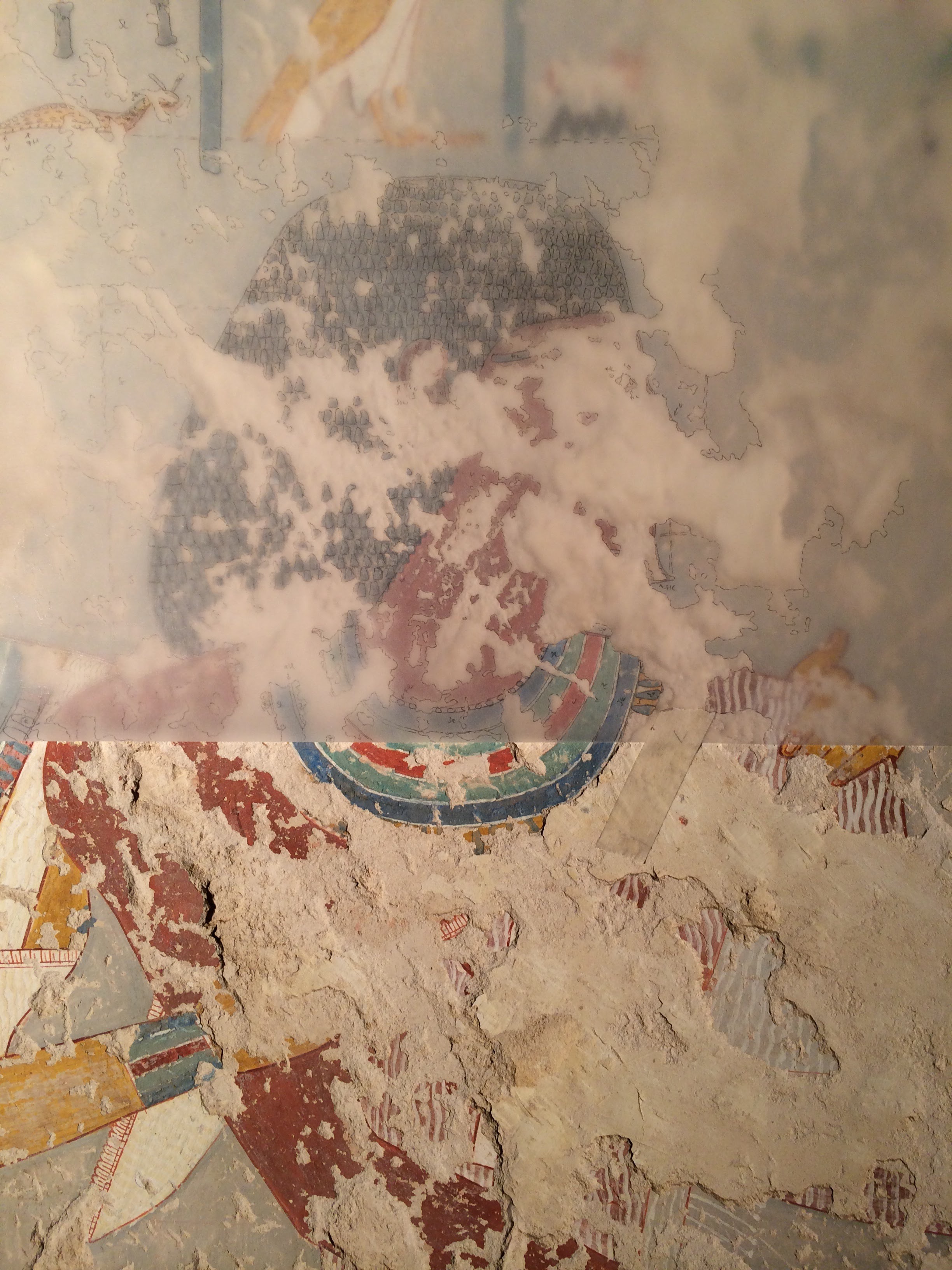
Tracing Nebamun's "sculpted" painted wig onto transparent paper in the Eighteenth dynasty Theban Tomb 179, 2014.
To represent the painted surfaces, Krisztián refined a grayscale color-coding system that translated hue into patterned tonal values. A key innovation was the digitization of the system itself. Hand-drawn pattern samples were scanned and transformed into repeatable digital textures, which could be applied efficiently while remaining visually consistent with earlier manual work. For sensitive areas, individual hand-drawn dots were still added, preserving the tactile quality of the facsimile. The resulting drawings remained stylistically homogeneous across analogue and digital phases.
Perhaps most importantly, this method proved especially powerful in addressing the tomb’s most fragmentary areas. Hundreds of loose painted fragments were documented individually and then digitally reassembled. Minute clues such as brushwork, color transitions, and woodgrain patterns made it possible to reconnect fragments to their original positions. The reconstruction of the so-called Abydos pilgrimage scene on the western wall illustrates this approach at its fullest.[6] Based on surviving fragments and parallels from other New Kingdom tombs, the two-register composition – depicting the journey to Abydos and the return – could be reconstructed and reintegrated into the broader decorative program.
In TT 179, the long-standing goal of presenting tomb scenes in their entirety was limited by the volume and complexity of the visual data. The combination of relief, paint, damage, and fragmentation could not be brought together on a single drawing without a significant loss of clarity. The use of grayscale color coding, together with layered digital documentation, allowed Krisztián to address this problem by organizing and viewing large painted compositions as coherent units. Rather than compressing all information into one fixed image, the system made it possible to distribute and compare different categories of data while preserving their spatial relationships.
Axial Hall, West Wall, Tomb of Nebamun, TT179 (reconstruction).
Documenting and Reconstructing the Late Roman Murals in the Emperor’s Chamber at Luxor Temple, 2013-2023
.gif)
Luxor Temple, Roman fresco drawing in relation with 18th Dynasty relief.
The Late Roman frescoes in the Imperial Cult Chamber at Luxor Temple survive today only in a highly fragmentary state. Painted during the tetrarchic refurbishment of the temple, they were already partly damaged when the chamber was first cleared in the nineteenth century. Since then, continued exposure, environmental conditions, and human activity have further reduced the paintings, so that in many areas only faint pigment traces remain, often without forming complete or easily legible figures.
Despite this, the chamber preserves a unique body of evidence for the late transformation of Luxor Temple. Shortly after it was cleared, a number of travelers, among them John Gardner Wilkinson in around 1856, recorded the frescoes through sketches, watercolors, and early photographs, providing visual documentation of features that have since deteriorated or disappeared. In recent years, a major conservation campaign led by the American Research Center in Egypt, in collaboration with the Epigraphic Survey and Italian wall-painting conservators, stabilized and thoroughly documented the remains. Their work culminated in the volume Art of Empire (2015)[7], which now stands as the definitive reference for the chamber’s historical and material context.
Despite this, the continued deterioration of the frescoes and the unresolved question of their long-term protection prompted the Epigraphic Survey to undertake a complete epigraphic documentation of the room. From the outset, Krisztián faced a fundamental problem: how could drawings contribute meaningfully when the paintings survived only as scattered, eroded traces? Traditional outline drawing would have reduced the remains to schematic shapes, stripping away their painterly character and masking the true extent of their loss. At the same time, photography alone – however detailed – could not clarify the faint, ambiguous marks left on the surface.
Krisztián therefore developed a method that treated texture, not outline, as the primary vehicle of representation. Instead of drawing contours, he reinforced every visible pigment trace with a fine, cross-hatched pencil texture, gradually building a tonal impression of the mural directly on photographic enlargements. Even the smallest specks of paint were recorded, allowing the eye to reconstruct forms where no continuous lines survived. The aim was not to reconstruct missing imagery, but to register and clarify the surviving traces as accurately as possible.
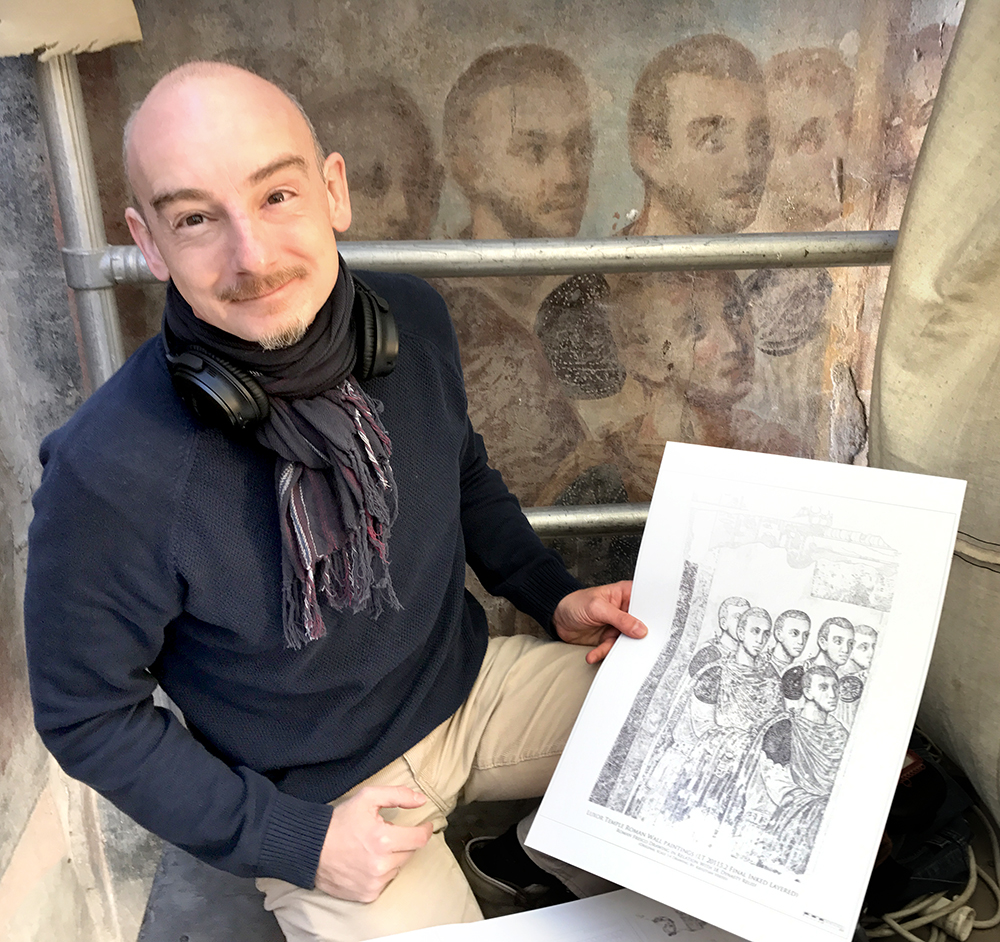
Krisztián Vértes in the Imperial Cult Chamber, 2017.
These textured drawings were then transferred into a digital environment, where the photographic background could be removed and the pencil textures refined. To convey depth and stylistic character, the fresco was separated into multiple tonal layers: a medium layer representing the main body of the paint, a darker layer emphasizing features such as faces, garments, and architectural panels, and a lighter layer indicating surviving background areas. By varying the opacity of these layers, Krisztián could “paint” with a single black brush while producing a full range of greyscale tones. The result was not a copy of the photograph, but a graphic impression that echoed the Roman painter’s hand – capturing even the faintest brushstrokes while eliminating visual noise.
Where the Late Roman paint had fallen away, the underlying Pharaonic relief was still visible. This older decoration was documented according to the digital Chicago House method, but rendered in light grey so that it remained visually subordinate to the fresco. By adjusting layer opacity, the relationship between the two decorative systems – Roman paint and Egyptian relief – could be explored, emphasized, or suppressed as needed. The file thus became a flexible visual archive in which different histories could be brought into dialogue.
Because the surviving fresco fragments appeared as isolated “islands” on the wall, a final unifying step was required. A discreet, single-weight line drawing of the essential Pharaonic relief was introduced to provide a visual framework that held the composition together. This lightweight map of the original wall decoration allowed the viewer to understand where the Roman paintings once belonged, without overwhelming the fragile remains.
Archival sources further enriched the record. Wilkinson’s watercolors and early photographs – carefully aligned with modern photogrammetric orthomosaics – made it possible to visualize details that have since disappeared. In the most devastated areas, such as the eastern wall with its once monumental scene of soldiers and horses, these historical images were used to create restrained, clearly differentiated reconstructions. Shown in lighter tones and simplified form, they were never meant to replace the original, but to preserve its memory and context.
Rather than producing a single, fixed image, Krisztián developed a layered visual system in which photographs, drawings, pigment traces, and reconstructed elements could be viewed together while remaining clearly distinguishable. The Emperor’s Chamber thus became a clear example of his digital epigraphic approach: documentation is not limited to recording what survives, but also to organizing fragmentary and incomplete data so that it can be examined and interpreted without implying a complete or restored original.
.gif)
Roman fresco drawing in relation to Wilkinson’s watercolors.
Conclusion
Krisztián believed that in digital epigraphy the design of the workspace – its tools, layers, and file structure – was just as important as the drawing process itself. Flexibility and sensitivity in documentation are essential. Digital drawing does not mean faster or easier work; on the contrary, producing stylistically consistent and highly accurate representations of ancient Egyptian art remains a time-consuming process that must be grounded in careful observation and thorough background research.
Although the five projects discussed here differ greatly in appearance and technical approach, they are all based on the same design language and working philosophy. Each treats architecture, relief, paint, damage, and reconstruction as parts of a single visual system, oriented toward the monument as a whole rather than toward isolated details. This unified structure makes it possible to address even the most complex or fragmentary material without reducing it to a single, oversimplified image.
For Krisztián, digital epigraphy – and epigraphy more broadly – remained meaningful only when a close connection was preserved between the ancient artwork and its interpretation. In all four digital cases, this connection was maintained through hybrid methods rooted in traditional, hand-drawn practice. The physical act of sitting at the wall, observing, drawing, and comparing was not replaced by digital tools, but strengthened by them. From the simplest pencil stroke to the most complex color texture, every digital element remained grounded in its conventional counterpart, ensuring continuity and comparability within the wider documentation framework.
Whenever the limits of a method became apparent, a new solution had to be developed – especially in a field shaped by rapidly changing technologies. At the same time, the documentation process, and particularly digital field drawing, was kept as clear and simple as possible. Above all, the human presence behind the drawing was preserved, because it is this sensitivity that gives meaning to even the most advanced digital representation.
A third article will follow, focusing on Krisztián’s more recent work at the Museo Egizio in Turin and the projects developed during the final years of his career.
I would like to thank former Survey director W. Raymond Johnson, current director J. Brett McClain, Museo Egizio director Christian Greco, and Zsolt Vasáros, architect and director of the Hungarian field mission in el-Khokha, for their support, generosity and for recognizing the importance of Krisztián’s work.
°°°
[1]For the history of the tomb, see Bács, T. A. “First preliminary report on the work of the Hungarian Mission in Thebes in Theban Tomb No 65 (Nebamun/lmiseba)”, in Mitteilungen des Deutschen Archäologischen lnstituts, Abteilung Kairo 54 (1998): 49-64.
[2] Vértes, K. 2020. “Tradition and Innovation in Digital Epigraphy”, in The Oxford Handbook of Egyptian Epigraphy and Paleography. Oxford: Oxford University Press.
[3] For a detailed study on the Chicago method see McClain, J. Brett, 2020 “The Chicago House Method”, in The Oxford Handbook of Egyptian Epigraphy and Palaeography. Oxford: Oxford University Press.
[4] Vértes, K. 2020. “Tradition and Innovation in Digital Epigraphy”, in The Oxford Handbook of Egyptian Epigraphy and Palaeography. Oxford: Oxford University Press.
[5] Vértes, K. 2024. “History of the Painted Decoration of the Peripteros and Façade" in: Medinet Habu X. The Eighteenth Dynasty Temple, Part II: The Façade, Pillars, and Architrave Inscriptions of the Thutmosid Peripteros, with translations of texts, commentary, and glossary. ISACP 1.
[6] For a detailed project description, see Schreiber, G. – R. Vadas – K. Vértes: “The ‘Abydos Pilgrimage’: A reconstructed sequence of scenes in Theban Tomb 179”, in Hungarian Archaeology E-Journal, 2018 Autumn.
[7] Jones, M. and S. McFadden (eds), 2015: Art of Empire: The Roman Frescoes and Imperial Cult Chamber in Luxor Temple (Yale University Press).
1 comment(s)
Dominique
Jan 30, 2026Dear Juli, Part II of Krisztián’s Memoriam is remarkable, reflecting on five distinct projects with such varied approaches that show how Krisztián was determined from the outset of his remarkable career to find the most meticulous and artistic solutions, exploring ever-evolving technical methods to beautifully document the complexity and elegance of ancient Egyptian artworks. He was truly dedicated to advancing methodologies in the field, passionate and persevering, and so inspiring. Your article is, once again, so beautifully written and truly honoring Krisztián’s memory, spirit, and love for Egyptology. You are amazing! I look forward to Part III and learning more about his contributions to Museo Egizio! Much love, Dominique

Apr 10, 2026Dear Dominique, Thank you very much for your thoughtful and generous response. I am glad that this second part of the series conveys the breadth of Krisztián’s work and his continuous engagement with both the technical and interpretive challenges of documenting ancient Egyptian material. One of the aims of this series is precisely to highlight how each project reflects a deliberate methodological choice, shaped by the specific conditions and questions of the material at hand. I appreciate your kind words and your interest in the continuation of the series. The next instalment will focus on a stela he work on at Museo Egizio. With best regards, Juli
Leave a comment(We'll keep your email address private)